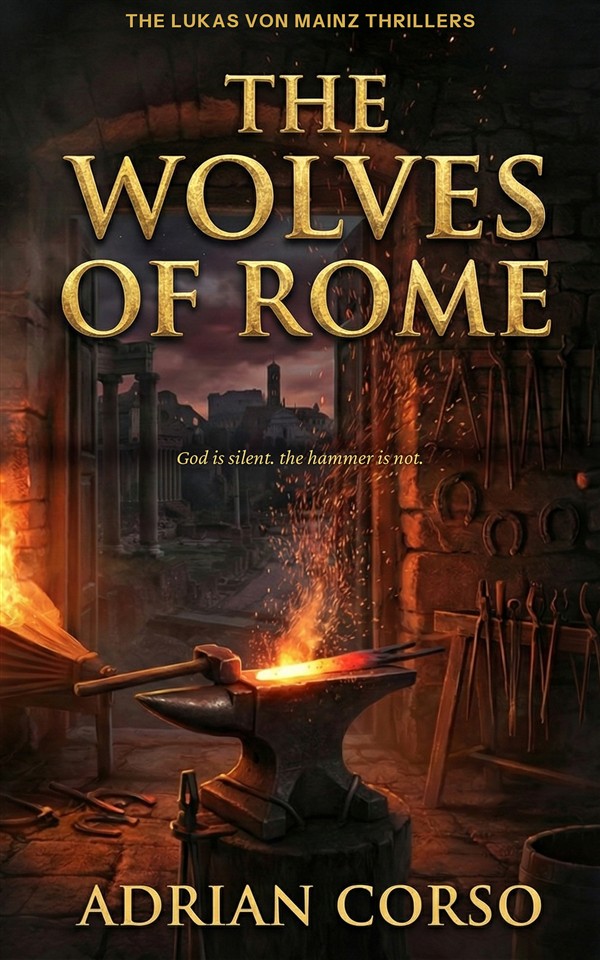
The Wolves of Rome
Rome was marble and bones. Twenty thousand people living in a city built for a million.
Giorgio is a blacksmith in the Suburra whose anvil is his altar. But when papal soldiers violently breach his forge seeking his wife Stefanetta, Giorgio’s quiet life is shattered. Armed only with his hammer, he fights back against an overwhelming force.
Enter Lukas Von Mainz, drawn into a conflict that threatens to consume the remnants of Rome. The ruins are no longer just monuments; they are the battleground for a hidden war involving popes, peasants, and a terrifying legacy.
Read the Opening
The Suburra woke the way it always did: slowly, and with regret.
Somewhere down the Vicus Sceleratus, a woman was shouting at a mule. The mule was winning. A rooster crowed from the roof of what had once been a senator’s villa and was now a tannery, and the sound echoed off marble facades that still bore the names of families dead for six hundred years. The street itself was mud and offal and the memory of grandeur.
Rome was marble and bones. Twenty thousand people living in a city built for a million. The ruins were not monuments. They were building materials. A butcher in the old Forum had walled his shop with pieces of a triumphal arch, and the carved legionaries on the frieze now watched over sausage casings with the same blank discipline they’d carried into Gaul.
The forge stood at the bend of the street where the cobblestones gave way to packed earth. It was small. Stone walls, timber roof, a chimney that drew well because Giorgio had rebuilt it twice until it did. The doors were oak. The threshold was a slab of travertine that had come from somewhere old and important, carried here on a mule cart, leveled with sand, set right.
Inside, the air was different. Cleaner. Hotter, but cleaner. The charcoal had been burning since before dawn and the heat pressed outward from the forge mouth in waves that turned the room into something almost sacred. The tools hung on the wall in an order that never changed: tongs on the left, graduated by jaw width; hammers in the center, lightest to heaviest; punches, chisels, and fullers on the right.
The anvil was his altar. The hammer was his prayer. And the prayer was always answered, because metal did not lie, and heat was not political, and gravity worked the same way for popes and peasants.
Giorgio stood at the anvil. His hands were already dark with soot, his leather apron scarred from a decade of sparks, his forearms latticed with old burns that had healed shiny and tight. He did not think about these things. The iron.
One.
The iron was ready. Orange at the edges, white at the center. Three breaths past perfect, if he was honest, but the metal would forgive him. Metal always forgave him. It was the only thing that did.
Two.
The hammer fell. Sixteen pounds of iron head on an oak handle worn smooth by ten thousand mornings exactly like this one. The steel flattened, spread, sang.