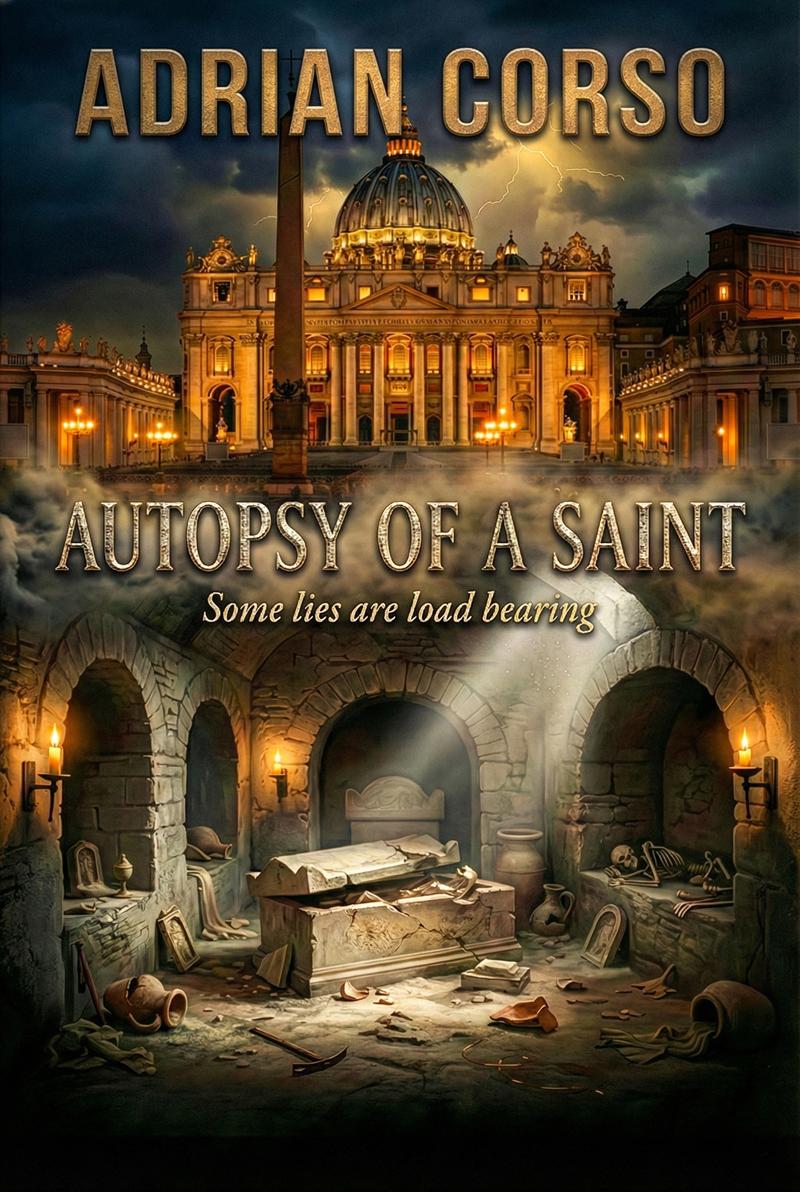
Autopsy of a Saint
Truth was a tool. Use it wrong, and people died.
Dr. Aris Thorne's scientific analysis of the blood of San Gennaro in Naples reveals a truth that shatters a six-century-old miracle. When his secret report coincides with a catastrophic failure of the relic, the resulting riot claims innocent lives and leaves Thorne with blood on his hands.
Fleeing to London, Thorne is haunted by the consequences of his uncompromising pursuit of fact over faith. But when the catacombs beneath Rome reveal structural anomalies tied to an even older secret, Thorne is drawn into a new mystery where the boundaries between science, history, and the sacred blur in deadly ways.
Read the Opening
The blood of San Gennaro refused to liquefy.
Dr. Aris Thorne stood at the edge of the cathedral square, watching two hundred thousand people learn that their patron saint had abandoned them. The September heat pressed down on the crowd like a physical weight: thirty-four degrees Celsius, humidity thick enough to taste. Wax candles sweated in their holders. The smell of incense mixed with the sharper notes of human perspiration, of fear beginning to ferment beneath the festival atmosphere.
He had come to observe. The University of Naples had paid him to analyze the reliquary’s contents, and the analysis was complete: the substance inside the ancient vials was not blood. Medieval chemistry, brilliantly engineered. A thixotropic compound that responded to temperature and agitation, performing its miracle on schedule three times per year for six centuries. Someone in the fourteenth century had understood material science at a level that would have impressed modern engineers.
The report sat in his hotel room, waiting for delivery. Four days of careful analysis, reduced to twelve pages of documentation. The truth about Naples’ most sacred relic.
He had thought he was being responsible. Thorough. Scientific.
He had not understood what he was holding.
The procession had been moving through the square for forty minutes, the silver reliquary carried on its platform by men in ceremonial robes. The Archbishop walked behind, hands folded, face composed in the particular expression of someone performing a ritual they had performed a thousand times before. The crowd pressed forward, reaching toward the reliquary as it passed, touching the hands of the bearers, crossing themselves, weeping.
Faith made visible. Faith made tangible. Faith condensed into a silver container and the red substance within.
The reliquary reached the cathedral steps. The Archbishop mounted the platform where, for six centuries, his predecessors had held the vials aloft and waited for the miracle. The crowd fell silent. Two hundred thousand people holding their breath.
The shift came before understanding.
It started at the edges, a change in posture, in the way bodies oriented toward the platform. The murmur that had been anticipation becoming something else. Thorne tracked the transformation with clinical attention: the tightening of shoulders, the forward lean that preceded aggression, the collective inhalation that preceded screaming.
The blood wasn’t liquefying.