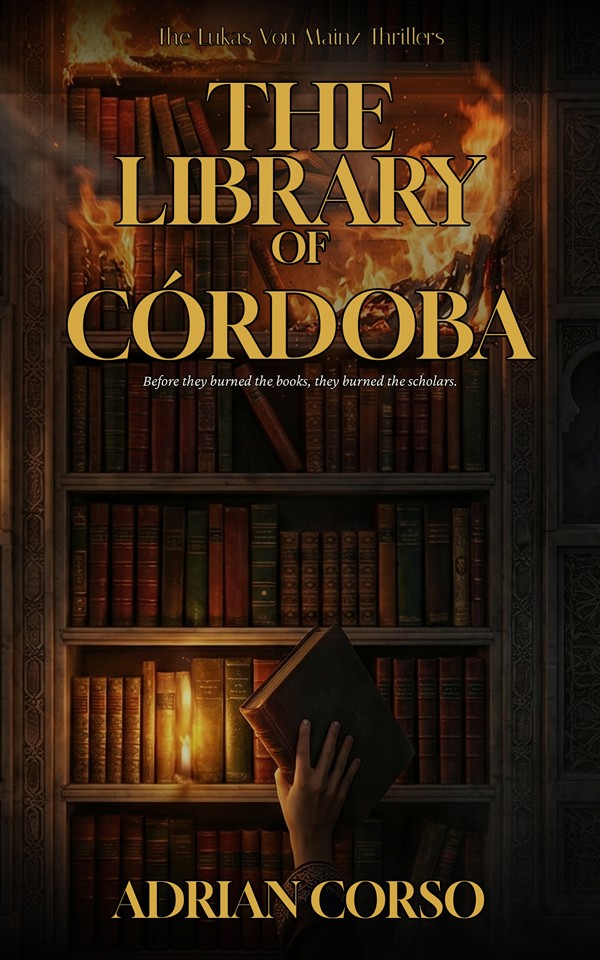
The Library of Córdoba
A dead caliph. A city of wonders. A devastating succession struggle where knowledge is the ultimate weapon.
October 976 AD. In the brilliant, advanced city of Córdoba, the scholar-caliph Al-Hakam II dies, leaving the most sophisticated civilization in Europe headless. Behind the scenes, ruthless generals, ambitious eunuchs, and a powerful queen mother begin maneuvering for ultimate control of al-Andalus.
Into this vacuum steps Lukas Von Mainz, an intelligence envoy for the Holy Roman Empire. His mission: access the fabled Great Library of Córdoba—a repository of four hundred thousand volumes—and steal military and engineering secrets that could turn the tide of war for Emperor Otto.
But when Lukas is drawn into the brutal palace politics of Madinat al-Zahra, he realizes that the greatest threat isn’t the city’s armies, but the hidden factions willing to sacrifice the empire’s soul for power.
Read the Opening
October 1, 976 AD. Madinat al-Zahra, al-Andalus.
The scholar-caliph died with ink on his fingers.
They had washed his hands twice that morning. Rosewater first, the attendants pouring it from a copper ewer engraved with Kufic script, the water running pink over the dying man’s knuckles and pooling on the marble slab beneath his wrists. Then camphor, applied with cotton pads while the physicians argued behind a curtain of Yemeni silk.
But the ink remained. It had seeped into the whorls of his fingertips, into the creases of his knuckles, staining the half-moons of his nails a permanent blue-black. Forty years of marginalia. Forty years of annotations, corrections, cross-references written in a hand so precise that his librarians could identify his notes at a glance across a crowded page.
The ink would not come out. It had become him.
Al-Hakam II, Commander of the Faithful, Caliph of Córdoba, ruler of al-Andalus and all its dominions, lay on cushions of Byzantine silk in a chamber that smelled of sandalwood and the sour undertone of slow death.
Through the latticed windows of the upper terrace, the library was visible. His library. Four hundred thousand volumes arranged in marble compartments that climbed the walls of reading rooms engineered for temperature and humidity.
Four hundred thousand volumes. The catalogue alone filled forty-four books.
Paris, seven hundred leagues to the north, did not have four hundred books in the entire city.
Outside, the adhan rose from the forty-seven-meter minaret of the Great Mosque, the muezzin’s voice carrying the elongated syllables of the Shahada across the rooftops of a city of three hundred thousand souls.
In the caliph’s chamber, no one was praying. The physicians were counting breaths. The attendants were watching the physicians. The air was heavy and still and smelled of camphor and sandalwood and the thing beneath those smells that no incense could disguise.